September 2026
One bug, everyone's fix
When you buy software, you buy its bugs too.
Nobody puts that in the proposal. But it is the deal almost every founder signs. A developer builds your product, sends the invoice, and moves on to the next client. From that day, every fault in the thing is yours. You do not find bugs by looking for them, because you do not know how to look. You find them when a customer is angry, and then you pay by the hour to get each one fixed.
If you have already tried building something with a no-code tool, you know the quieter version of the same problem. The thing mostly works. And when it stops working, nothing tells you. Your customers tell you.
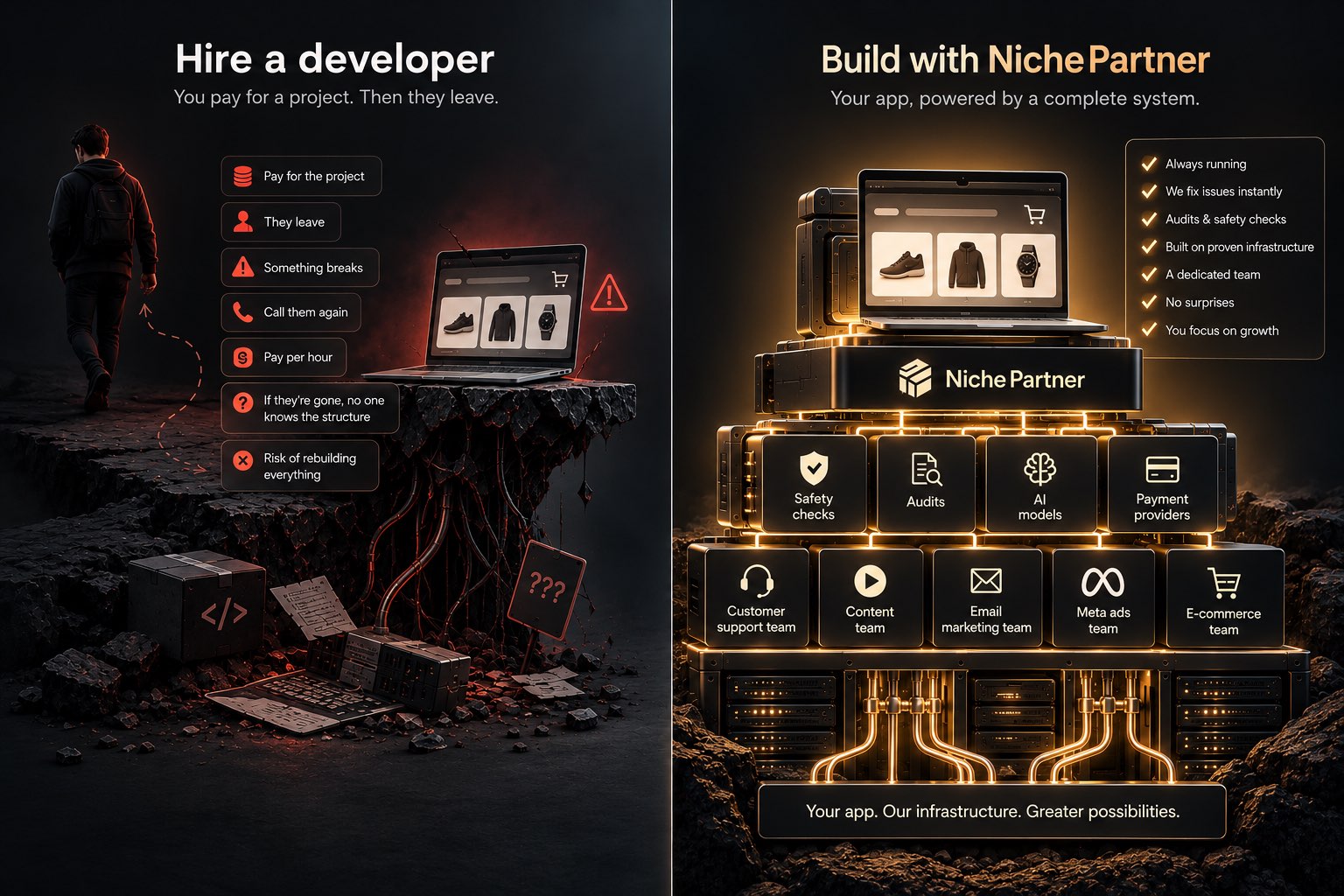
What does it mean that your product runs on a system?
Here is one piece of how our setup works, and it is the piece we would want explained to us if we were on the other side of the table.
Your product does not run alone. It runs on the same system as our own businesses. Same foundations, same machinery underneath. That is not a hosting detail. It changes who finds your bugs, and who pays to find them.
What happens when a bug turns up?
When a fault shows up anywhere on the system, in any one business, every business on it gets checked for the same fault. Yours included. Straight away, on our budget, and usually before your customers ever notice anything.
Think of a restaurant chain. When one kitchen finds a fault in the fryer, every kitchen in the chain gets the fix the same day. The independent place across the street finds out when the oil burns. He is not worse at running a restaurant. He is just alone with his equipment.
That is what you are stepping out of. Not the work of running a business, but the loneliness of owning every technical fault in it yourself, and learning about each one from the person you least want to hear it from.
Does that mean nothing ever breaks?
No, and anyone who promises you that is selling something.
Bugs still happen. Software that runs in the real world breaks in the real world, ours included. The honest version of the promise is smaller and worth more: on a shared system, a bug happens once, across all of us, instead of once in each business. The finding is shared, the fix is shared, and the cost of both sits on our side of the table.
And one boundary matters enough to state plainly, because it is the first thing we would ask: code travels between us. Customers never do. What we learn about faults and fixes moves across the system. Who your customers are, and everything about them, stays yours.
You run the business. We run the system.
That line is the whole split, and the audits are just what it looks like from underneath. You win the customers, hold the relationships, set the direction and the prices. We keep the machinery under your product working, and when something breaks anywhere, we go looking in yours before your customers do.
We will not operate the business. That part is yours, and it is the part your network and your niche knowledge were always going to be for.
If you are holding a half-working thing right now and wondering who owns its bugs, you already know the answer. If you would rather that answer be us, send a DM, or read how the rest of the system fits together right here on the site.