September 2026
The teams you plug into
When people picture plugging into a system, they picture software. The servers, the models, the payments — the plumbing. That part is real and it matters, but it is not the part that decides whether your business works.
The part that decides it is the teams. Five functions that already exist, already know what they are doing, and start working on your business the moment it is on the system.
Here is each one, and what it means for you specifically.
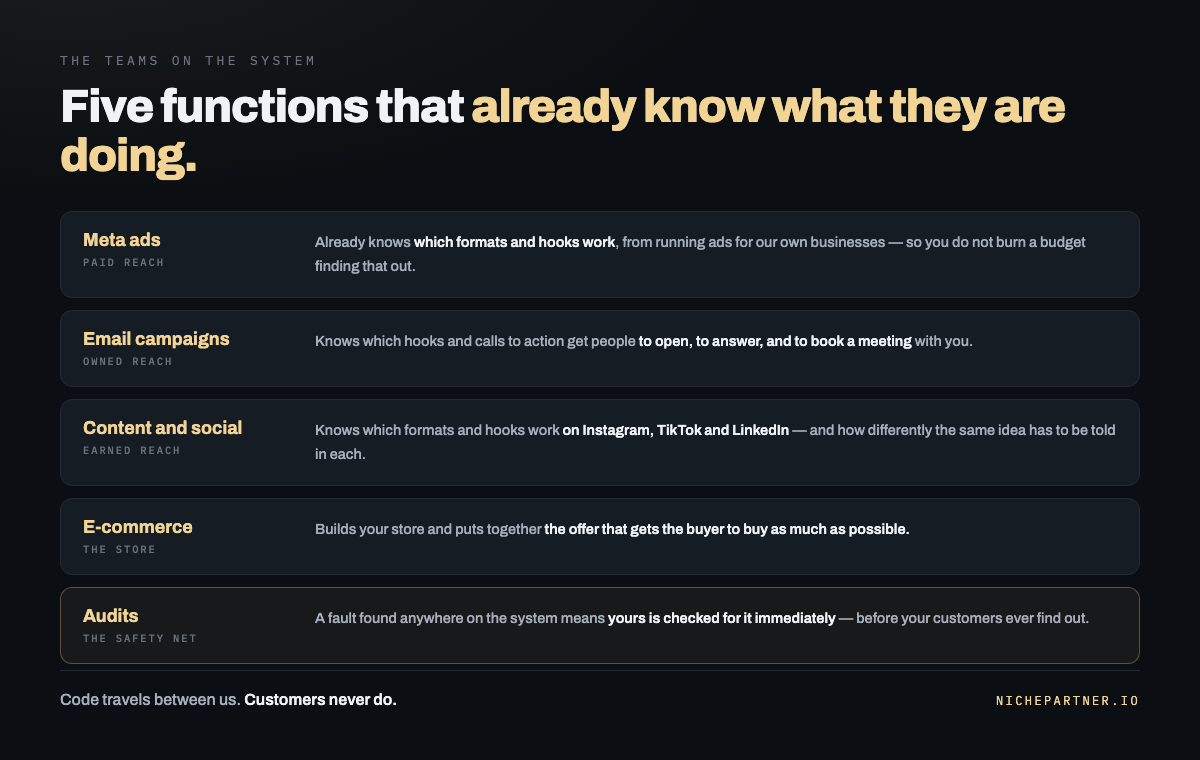
Meta ads
Our Meta ads team already knows which formats and hooks work, from running ads for our own businesses.
What that removes is the most expensive month of a new business: the one where you find out what does not work. You do not know yet which opening line makes someone stop scrolling, whether a short video beats a single still image, whether buyers respond to the price, the speed or the guarantee. Everyone answers those questions the same way — by spending real money on versions that turn out to be wrong.
The shapes that survive that search are mostly not specific to one business. The sentence changes; the shape does not. So your first campaign does not start at zero, and the budget that would have gone on finding the shape goes on reaching people.
Email campaigns
Our email marketing team knows which hooks and calls to action get people to open, to answer, and to book a meeting with you.
Email looks like the simplest channel and is not. Every part of it has an answer that costs a list to learn: which subject line gets opened rather than ignored, which ask gets a real reply, how long you wait before following up, and how many follow-ups you get before you become the thing someone unsubscribes from.
For a business whose customers arrive through relationships — which is most niches worth being in — this is often the channel that carries the revenue. It is also the one people improvise, because it feels like just writing.
Content and social
Our content team knows which formats and hooks work on Instagram, TikTok and LinkedIn.
The hard part is not producing content. It is that the same idea has to be told differently in each of those rooms, and the differences are not obvious until you have failed in all three. What earns attention on TikTok dies on LinkedIn. What works on LinkedIn is too slow for Instagram.
This is also the function that compounds fastest, because what works changes constantly and the learning has to be continuous. A team doing it across several businesses sees the shift long before a single business would notice its numbers slipping.
E-commerce
Our e-com team builds your store and puts together the offer that gets the buyer to buy as much as possible.
Two separate skills sit in that sentence and the second is the one people underestimate. Building a store is a solved problem. Assembling an offer is not: what to lead with, what sits next to what, what gets added at the last step, what turns one purchase into three.
That is not a design question. It is a question about what the buyer in your niche actually wants next, answered with the structure of the page.
Audits
The fifth is not a growth team, and it is the one you will be gladdest of.
If a bug turns up anywhere on the system, yours is audited for the same bug immediately — before your customers ever find out.
This is the clearest illustration of what being on a shared system means. On your own, you find your faults the way everyone does: a customer tells you, usually after it has cost you something. Here, a fault found once is checked for everywhere. The businesses on the system act as an early warning for each other.
And the boundary holds while that happens. Code travels between us. Customers never do.
What you would otherwise be doing
It is worth being concrete about the alternative, because 'we have teams' is easy to nod along to without registering what it replaces.
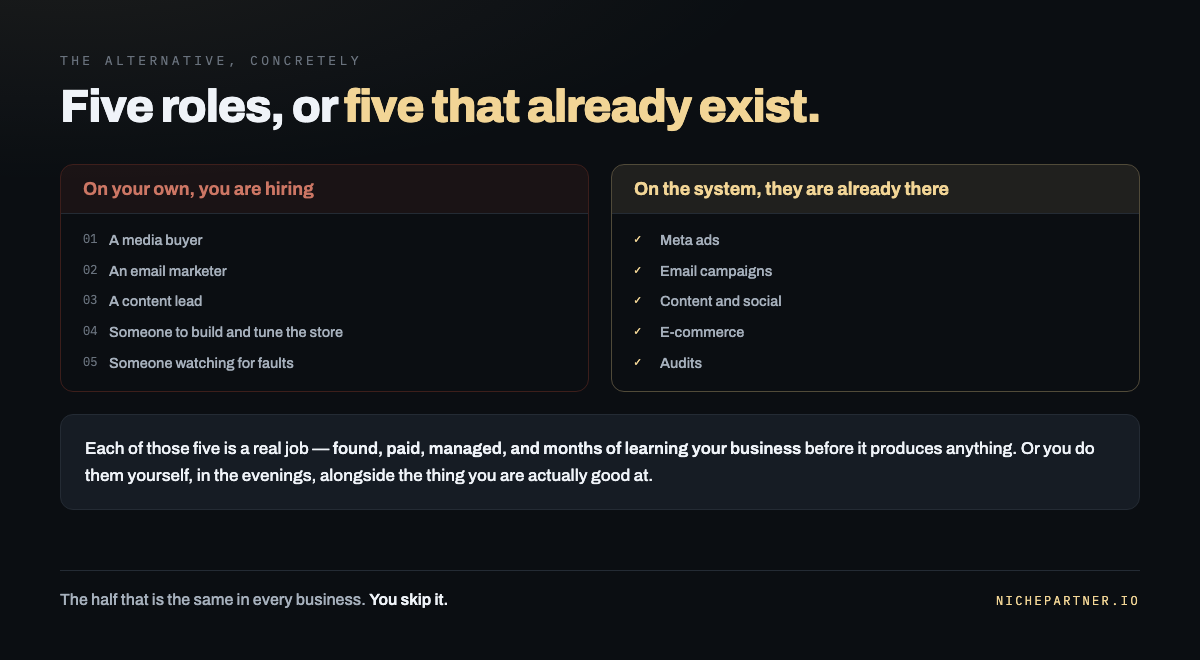
To cover these five yourself you would be hiring a media buyer, an email marketer, a content lead, someone to build and tune the store, and someone paying attention to whether anything is broken. Five roles. Each one needs finding, paying, managing, and months of learning your business before it produces anything.
Or you do them yourself, badly, in the evenings, while also doing the thing you are actually good at.
Most people in your position pick a third option without deciding to: they do the one they are most comfortable with and quietly hope the others do not matter. They matter.
Why they get better without you
Here is what makes this different from having good people on retainer.
When one of these teams learns something — a format that suddenly works, a subject line pattern that stops working, a checkout step that loses people — it does not get written up and circulated for everyone to remember. It goes into how the system works, and everything on the system has it from that moment.
So the version you plug into is better than the version that existed six months ago, and worse than the one that will exist six months from now. You get that improvement without asking for it, briefing anyone, or paying for it again.
What this does not do for you
These teams do not sell for you. They will not call the people in your network, and they will not decide what your product should be.
That is not a gap in the offer. Those are the things that need someone who knows the industry, and that is the half you already have. The teams handle the half that is the same in every business — which is the half that would otherwise cost you a year finding out.
You run the business. We run the system, and everything working inside it.