September 2026
What NichePartner is
The same argument as a conversation, in plain language. Both voices are synthetic — this is a generated discussion of the post below, not a recorded interview.
This is the one page that explains the whole thing. No jargon, nothing assumed. If you read only one thing about us, read this.
The short version
You know an industry. We know how to build and run software. You bring the customers; we build the product and keep it running. You own the business, we own the system underneath it, and we each do the part we are actually good at.
Who this is for
You have spent real time in an industry. You have worked in it, or sold into it, or run something inside it. You know what the people in it complain about, what they overpay for, and what they would switch to tomorrow if it existed. When you call someone in that world, they pick up.
What you do not have is the thing to sell them. You have an idea for it. You may even have tried to build it. What stopped you was not the idea and not the selling — it was everything in between.
Why not just hire a developer
This is the first real question, so it gets answered before anything else.
There are two normal routes from an idea to a product. The first is to build it yourself with a no-code tool. This works better than people expect for about a month. You get something you can show people. Then a real customer uses it in a way you did not imagine, or twenty people arrive at once, or a payment fails and nobody notices for three days — and it becomes clear that what you built is a demonstration, not a business.
The second is to pay a developer. This produces something sturdier and teaches you something expensive: the app was the cheap part. Nobody quotes for the rest. Hosting it. Keeping it up when it breaks at three in the morning. Payments, refunds, failed cards. Security. Somebody answering customers. The slow permanent grind of keeping software working while the world underneath it changes.
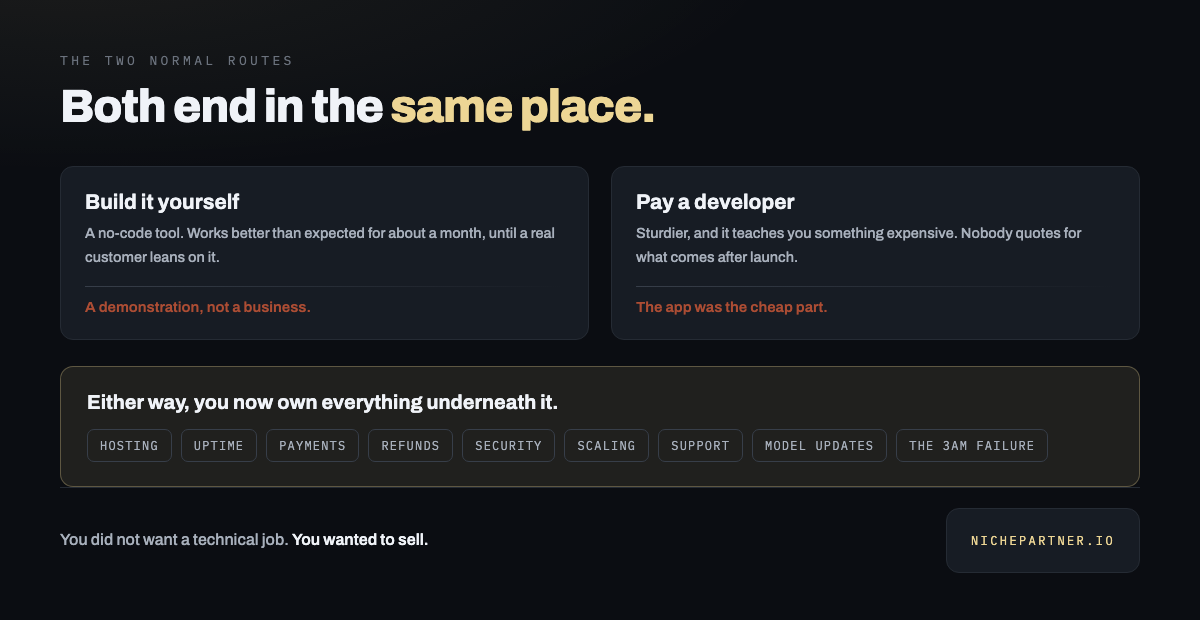
So both routes end in the same place. You now own everything underneath your product, and everything underneath your product is a full-time technical job. You did not want a technical job. You wanted to sell to people in an industry you understand.
There is a third thing that goes wrong with hiring a developer, and it is the one people notice a year later. A developer builds what you asked for, on the day you asked for it. The world underneath it keeps moving — better models arrive, providers change their rules, new kinds of attack appear — and none of that is anyone's job any more. Your product is frozen at the moment the invoice was paid.
What we actually do
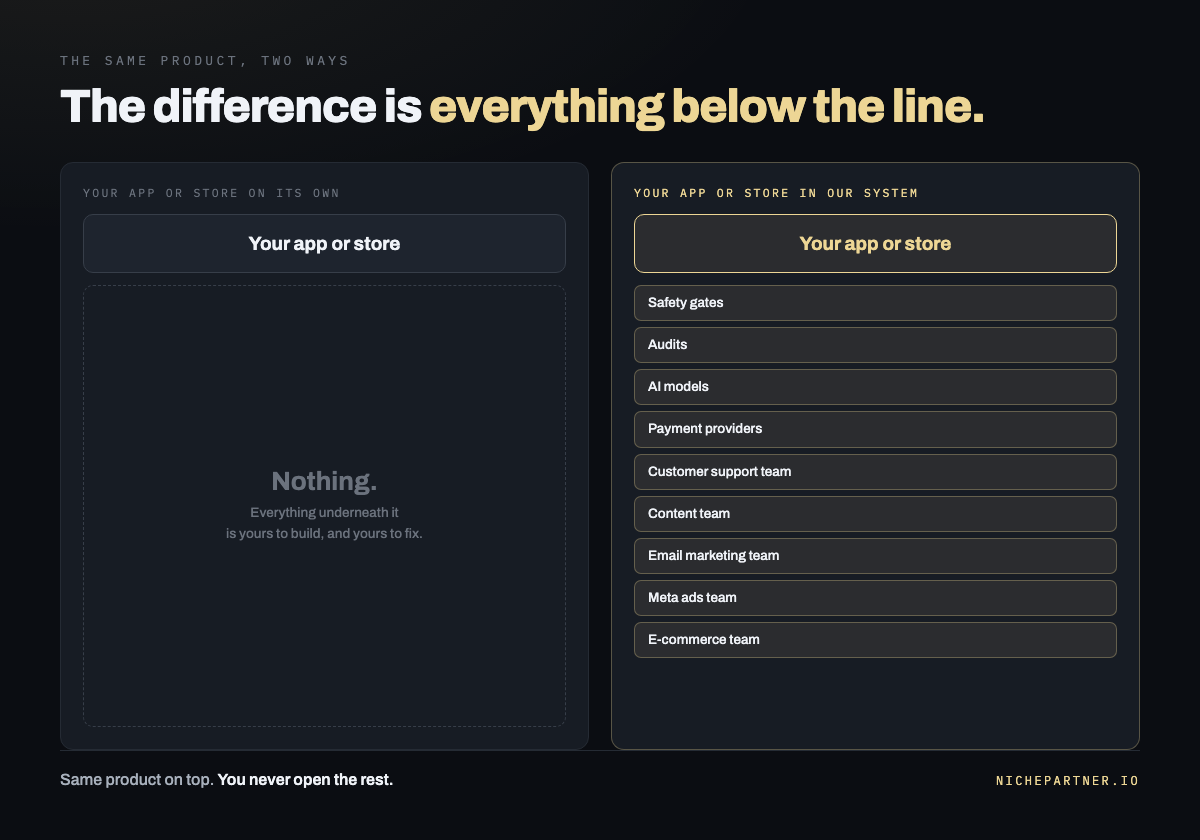
We run a system, and your product sits on top of it.
The system is the whole underneath. The servers and the platform. The AI models that do the thinking. The payments and the billing. The security, and the scaling when a lot of people turn up at once. Safety gates that every automated message passes through before it reaches one of your customers. Audits that keep checking all of it.
It also holds teams that have already learned the expensive lessons: what works in advertising, what gets an email opened and answered, what works on social, how to put a store and an offer together.
You never open any of it. That is the point, not a limitation. When a better AI model comes out, it goes in there and your product gets better without you doing anything. When the rules change, they change in one place. When a fault is found anywhere on the system, everything on the system is checked for it immediately.
Why it matters
Everything above is about work you avoid. This part is about something you gain, and it is the part that is hardest to see from outside.
There is a cost in starting a business that nobody puts in the plan, because it does not look like a cost while it is happening. It is the money and the months you spend finding out what does not work. It never arrives as an invoice. It arrives as a quiet month, an ad account that spent its budget and brought nothing back, a launch email nobody opened.
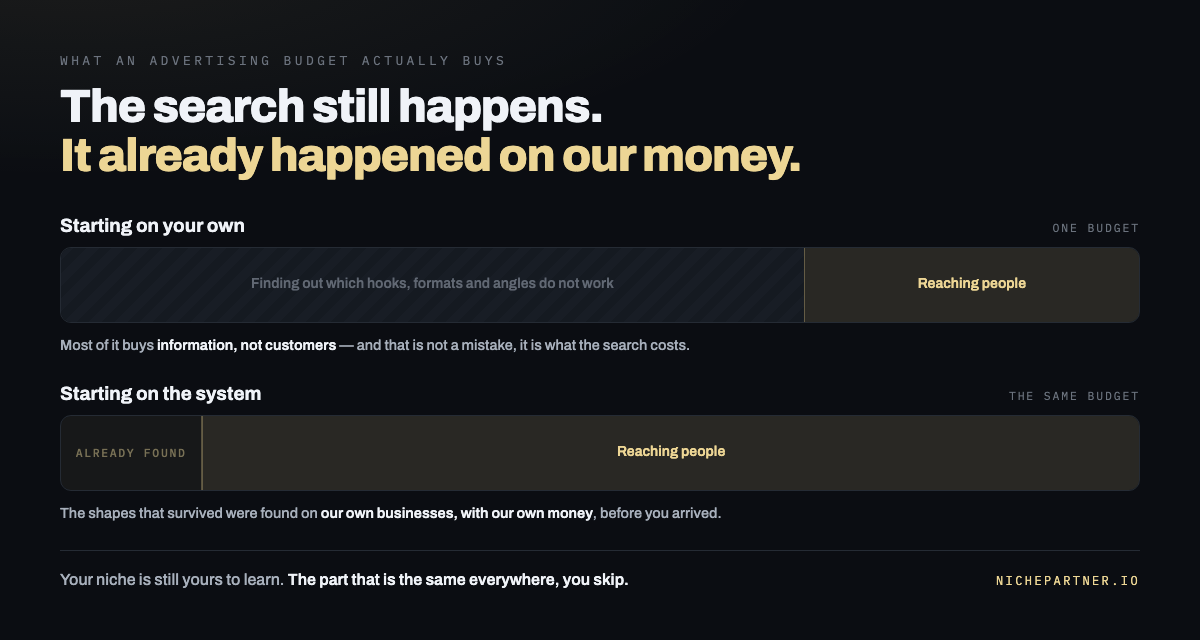
Take advertising, because most people have some feel for it. When you start, you are not buying customers. For the first stretch you are buying information. You do not yet know which opening line makes someone stop scrolling, whether your thing does better as a short video or a single image, whether buyers respond to the price, the speed or the guarantee. So you find out the only way there is: you run several versions, you spend real money on all of them, and most of that money buys you nothing except the knowledge that those versions do not work.
That is not a mistake in how you did it. That is what the process is. The winning version cannot be reasoned out in advance; it has to be found, and finding it costs whatever it costs.
Now the part that matters. The hooks and formats that survive that search are mostly not specific to one business. The particular sentence changes. The shape does not — the kind of opening that earns three more seconds, the length that holds attention, the sort of image that reads at thumbnail size on a phone. Our ads team has already run that search, by spending our own money on our own businesses and watching what came back.
The same is true of email: which subject line gets opened, which ask gets a reply, how long to wait before following up. And of content: what works on Instagram, on TikTok, on LinkedIn, and how differently the same idea has to be told in each. And of the store itself: how the offer is put together, what sits next to what.
The part that makes it compound
Here is the clearest way to see the difference between this and hiring good people.
Suppose one of the businesses on the system hires a content specialist — someone who genuinely knows how to write a hook, who understands why one format outperforms another, who has done it for years. In a normal company, that hire benefits that company. One business gets better at content; everyone else carries on as before.
On a shared system, that is not what happens. What that specialist works out does not stay where they work. It goes into the system — into how content is written for everything running on it. Every business on the system gets a better content operation the week that person starts, and keeps it if they leave.
That works in both directions, which is the honest way to put it. When we hire an expert, you get them. When the ads team learns something painful this month, you get that too. And it is why we can justify hiring specialists at all: the cost is carried once and the benefit lands everywhere, which is not a decision a single small business can usually make.
Compare that with an agency. You buy hours. What they learn while working for you is real, but it lives in their heads and leaves when the contract does. Hire them again next year and you pay for the same expertise again. Nothing you funded accumulated anywhere you own.
It also means the person who joins last starts furthest along. That is an unusual sentence in business, where being early is normally the advantage. Here, early and late both work — early because you grow alongside it, late because you inherit everything it learned before you showed up.
What is shared, and what is never shared
This is the question a careful person asks next, and it deserves a straight answer rather than reassurance.
What moves between the businesses on this system is what works: the shapes, the methods, the fixes, the gates, the specialists. What never moves is your side of it. Your customers are yours. Your list is yours. Your niche, your pricing, your relationships, your company.
Code travels between us. Customers never do.
How we split it
You run the business. Specifically: you sell, you own the customers and the relationships, you decide what the product should do next, you set the prices, you run the company day to day.
We run the system: the platform and the infrastructure, the product built and maintained, payments and billing, uptime and security and scaling.
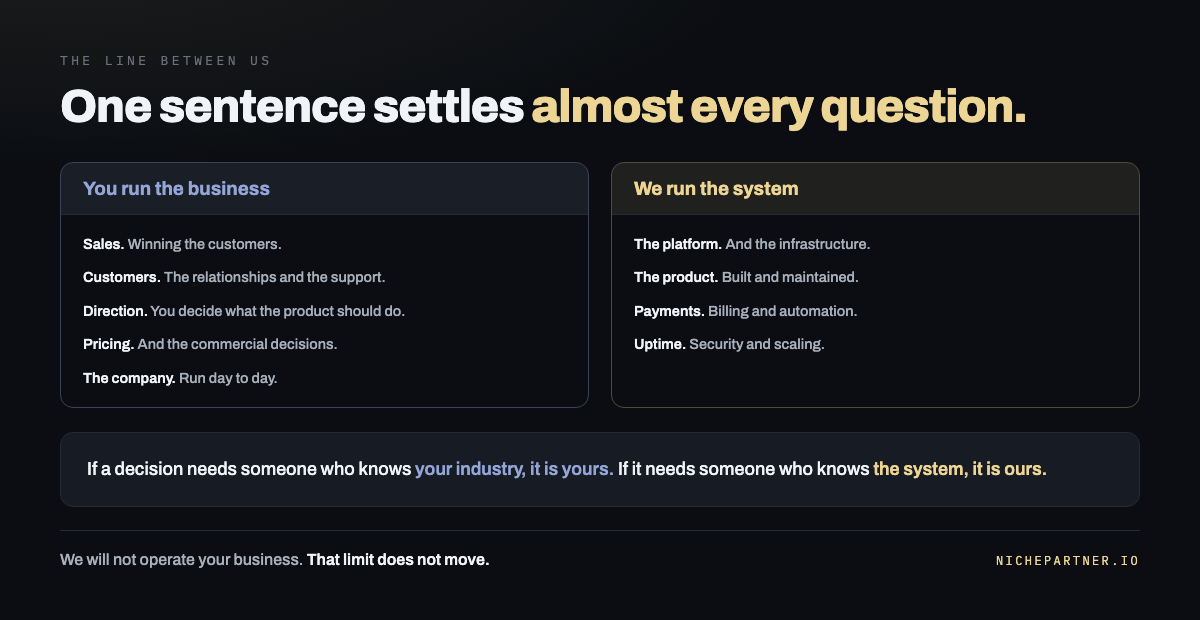
One sentence settles almost every question about who decides what. If a decision needs someone who knows your industry, it is yours. If it needs someone who knows the system, it is ours. Should the product do X instead of Y — yours. Should we move to a new model provider — ours. What to charge — yours. Why the checkout failed for one customer in Germany — ours.
The limit we will not move
We will not operate your business. We will not take your sales calls, manage your customers, chase your invoices or make your commercial decisions. That is the request that arrives most often, and the answer does not change.
It is not reluctance. It is what keeps your side of this genuinely yours. The customer relationships are the most valuable thing in your business, and the moment somebody else is running them they stop being entirely yours. So we stay out of them deliberately. What we take on is the part with no relationship in it at all — the platform, the product, the payments, the uptime — and you keep every conversation that decides whether someone buys from you again.
How the money works
Two invoices, and nothing hidden inside either one.
One is what the system genuinely costs to run for you — the hosting, the models, the payment processing. That is a real cost passed on, not a margin dressed up as a cost.
The other is what we agree between us. That part is a conversation, because a partner who arrives with a network and a clear idea is in a different position from one who needs the whole thing worked out from scratch, and one number for both would be wrong for both. Nothing about it is a surprise later. The business stays yours either way.
What this does not promise
It would be easy to finish here and let this sound like a guarantee, so it is worth saying plainly what it is not.
It does not mean your ads cannot fail. Your niche is yours, and it may behave in ways nothing we have run has behaved. It does not mean there is no work — you still have to sell, and selling is the hard part we deliberately do not take off you.
What it means is narrower and more useful than a guarantee. The part of the learning that is the same in every business, you skip. The part that is genuinely about your industry and your customers, you keep, because that part was always yours and it is the reason you are the one doing this.
How it starts
You get in touch and tell us the industry and the idea. We work out whether we are the right fit — sometimes we are not, and it is cheaper for everyone to find that out in a conversation than in a contract.
If it fits, we build your product on the system and you start selling it.
That is the whole model. You run the business. We run the system.